This study investigates pragmatic contexts and common ground in Nigerian STI/HIV doctor–patient interactions. Drawing on a dataset of thirty audio-recorded consultations from STI/HIV clinics in South-western Nigeria, the study applies Kecskes and Zhang’s Socio-Cognitive Approach to Common Ground (2009), complemented by Conversation Analysis (Sack et al, 1974), to identifying the pragmatic contexts of STI/HIV consultations and the common ground cues that facilitate the interpretation of actions and meanings across the contexts.
pp. 83-110
https://doi.org.10.33234/JSAR.2.8

Pragmatic Contexts and Common Ground in Nigerian STI/HIV Doctor-Patient Interactions
Oluwaseun Onaolapo AMUSA
Department of English Studies
Adekunle Ajasin University, Akungba-Akoko, Ondo State, Nigeria
oluwaseun.amusa@aaua.edu.ng / iamseunamusa@gmail.com
Pragmatic Contexts and Common Ground
in Nigerian STI/HIV Doctor-Patient Interactions
Oluwaseun Onaolapo AMUSA
Department of English Studies
Adekunle Ajasin University, Akungba-Akoko, Ondo State, Nigeria
oluwaseun.amusa@aaua.edu.ng / iamseunamusa@gmail.com
Abstract
This study investigates pragmatic contexts and common ground in Nigerian STI/HIV doctor–patient interactions. Drawing on a dataset of thirty audio-recorded consultations from STI/HIV clinics in South-western Nigeria, the study applies Kecskes and Zhang’s Socio-Cognitive Approach to Common Ground (2009), complemented by Conversation Analysis (Sack et al, 1974), to identifying the pragmatic contexts of STI/HIV consultations and the common ground cues that facilitate the interpretation of actions and meanings across the contexts. The analysis reveals two broad contexts: professional and social. The social context comprises phatic and affinity contexts, while the professional context encompasses diagnostic, therapy, didactic, and follow-up contexts. Findings show that the participants’ core common ground primarily sustains the social contexts of interaction, whereas both core and emergent common ground cues sustain the professional contexts. The study concludes that the participants’ shared knowledge enables them to interpret context-specific actions appropriately and cooperate effectively across the different contexts.
Key words: Pragmatics, Common Ground, Conversation Analysis, STI/HIV Doctor-Patient interaction
- Introduction
Doctor-patient interaction constitutes one of the most consequential forms of institutional communication because clinical encounters are not merely sites for biomedical exchange but also spaces where meanings, identities, emotions, and social realities are collaboratively negotiated. Within healthcare discourse, communication mediates virtually every aspect of medical practice. In highly sensitive medical domains such as sexually transmitted infections (STIs) and Human Immunodeficiency Virus (HIV) care, interaction assumes even greater significance because consultations frequently involve issues of stigma, sexuality, morality, fear, vulnerability, and confidentiality (Magnusson, 1994; Barfod et al., 2006; Brook et al., 2014). Consequently, successful clinical communication depends not solely on the transmission of medical information but also on participants’ ability to establish shared understanding and negotiate contextually appropriate meanings during interaction.
From a pragmatic perspective, meaning in interaction is not inherent in linguistic expressions alone but also emerges through interlocutors’ interpretation of contextual assumptions, background knowledge, sociocultural experiences, and situational cues (Kecskes, 2008; 2014). Clinical discourse, therefore, represents a dynamic interactional process in which doctors and patients continuously negotiate intentions, infer implicit meanings, manage interpersonal relations, and construct common ground. This becomes particularly relevant in multilingual and multicultural societies such as Nigeria, where communication is often shaped by diverse linguistic repertoires, sociocultural norms, and culturally situated understandings of illness and sexuality.
Nigerian STI/HIV consultations are embedded within complex socio-cultural realities that influence communicative behaviour. Discussions relating to sexual health and STIs in Nigeria are frequently mediated by cultural taboos, indirectness, euphemistic expressions, religious sensitivities, and concerns about social judgment (Smith, 2004; Awoleye et al., 2022; Amusa, 2025). Patients may strategically withhold information, minimise symptoms, avoid explicit lexical choices, or rely on culturally intelligible inferential meanings in discussing sexual practices and health conditions, particularly in contexts where stigma and moral judgement are socially salient (Heritage & Maynard, 2006; Amusa, 2025). Similarly, doctors may employ mitigation strategies, professional euphemisms, advisory formulations, and institutionally shaped discourse practices to manage sensitive consultations while simultaneously preserving professional authority, interpersonal rapport, and patient empathy (Brown & Levinson, 1987; Heritage & Maynard, 2006). These communicative choices shape how pragmatic contexts are constructed and how common ground emerges during clinical encounters.
The concept of common ground has occupied a central position in pragmatics, discourse studies, and interactional sociolinguistics. Traditionally associated with shared knowledge and mutual assumptions among interlocutors, common ground has increasingly been reconceptualised as a dynamic and interactionally emergent phenomenon rather than a static body of pre-existing shared information (Kecskes and Zhang, 2009; Kecskes, 2014). Within this reconceptualisation, Kecskes and Zhang’s socio-cognitive approach to common ground provides an important theoretical intervention by arguing that communication is shaped simultaneously by prior individual experiences and emergent situational interaction. According to Kecskes, interlocutors enter interaction with private and collective knowledge derived from socio-cultural experiences, yet meanings are continuously modified and renegotiated through actual communicative engagement.
This socio-cognitive understanding of common ground is particularly useful for analysing medical interactions because doctors and patients do not necessarily share identical understandings of medical terminology, illness experiences, sexual behaviour, or treatment implications. Consequently, common ground in clinical discourse cannot simply be assumed; rather, it must be interactively negotiated.
While studies on medical discourse have examined issues such as institutional power, politeness, patient-centred communication, discourse asymmetry, and healthcare interaction (Heritage & Maynard, 2006; Ainsworth-Vaughn, 1998; Pilnick & Dingwall, 2011; Aronsson & Sätterlund-Larsson, 1987), relatively limited attention has been paid to the socio-cognitive processes through which common ground is constructed in medical discourse and particularly, in Nigerian STI/HIV consultations. Existing studies on Nigerian medical discourse have largely focused on linguistic, discursive and pragmatic features of doctor-patient interactions (Odebunmi, 2003, 2005, 2006; Odebunmi and Amusa, 2016), politeness investigations (Amusa, 2016), concealment and news delivery strategies (Odebunmi, 2008, 2011); therapy negotiations (Odebunmi, 2016; Boluwaduro, 2020); generic structure potential (Amusa, 2023); turn incremental formulations (Amusa, 2022, 2023); and euphemisms (Amusa, 2025). Furthermore, except for Amusa (2025), very few studies have integrated Kecskes’ socio-cognitive theory with Conversation Analysis (CA) in examining naturally occurring medical encounters within African healthcare settings and Nigerian STI/HIV medical settings. This gap limits the understanding of how Nigerian doctors and patients collaboratively construct meaning during STI/HIV consultations and how shared knowledge influences correct inferencing of actions and successful transitions across the different pragmatic contexts of a medical consultation.
The present study investigates pragmatic contexts and common ground in Nigerian STI/HIV doctor-patient interactions using Kecskes and Zhang’s socio-cognitive approach to Common Ground (2009), complemented by Conversation Analysis (Sacks et al. 1974). The study shall identify the different pragmatic contexts that feature in STI/HIV consultation in Nigeria. It shall also reveal the common ground resources that sustain the interpretation of actions and meanings across the different contexts in the consultations. By foregrounding the interactional and socio-cognitive dimensions of medical discourse in a Nigerian context, the study contributes to ongoing scholarship in Pragmatics, medical discourse analysis, healthcare communication, and interactional studies, while also providing insights into the communicative realities of STI/HIV consultations in contemporary Nigerian healthcare settings.
- Methods
The data for the study was comprised of thirty audio-recorded doctor-patient consultations, collected from selected hospitals in South-West Nigeria. The data, which included part of the dataset collected for the doctoral study of the researcher, were gathered through non-participant observation and audio recording of naturally occurring consultations with the informed consent of participants. Ethical approval was received from the required authorities in the selected hospitals before data collection was done. Ethical considerations such as anonymity, confidentiality, and voluntary participation were strictly observed. Participants’ identities were anonymised through the use of pseudonyms and coded identifiers.
The audio-recorded consultations were transcribed using the Jeffersonian transcription notations to capture interactional details of the recordings. The data were subsequently analysed using Kecskes and Zhang’s (2009) Socio-Cognitive Approach (SCA) to Common Ground in conjunction with pragmatic insights on context and Conversation Analysis principles.
- Theoretical Insights and Analytical Framework
Kecskes and Zhang’s (2009) Socio-Cognitive Approach (SCA) to common ground attempts to reconcile two dominant opposing traditions within pragmatics. The first is the Cognitive-Philosophical Pragmatics School, which foregrounds speaker intention (conceptualised as apriori mental state that precedes and underpins communication) as the central determinant of meaning. The second is the Socio-cultural Pragmatics School, which views intention as interactionally achieved and progressively negotiated during communication. According to Kecskes (2008, 2014), communicative intention is shaped simultaneously by interlocutors’ prior socio-cultural experiences and by the immediate situational realities of interaction. Meaning, therefore, is neither entirely pre-constructed nor wholly emergent; rather, it evolves through the dynamic interplay between individual cognition and contextual interaction.
Central to SCA is the assumption that both individual and societal factors jointly shape communication. Individual features include attention, salience, egocentrism, and private experience, while societal features involve cooperation, relevance, shared situational experience, and socially recognisable communicative norms. Kecskes argues that interlocutors are not merely constrained by these social conditions; they also actively shape and reconstruct them during interaction. Communication is therefore viewed as a socio-cognitive process in which meaning emerges through the continuous interaction between personal knowledge and socially shared understanding.
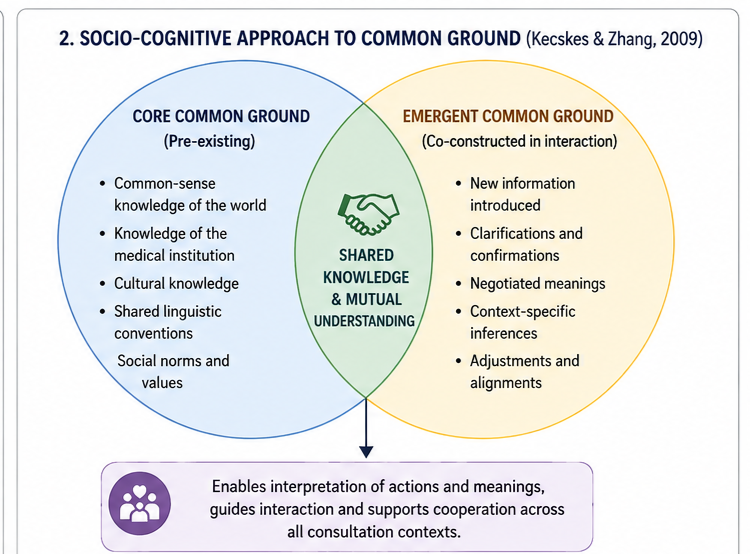
A major contribution of this approach is the reconceptualisation of common ground as a dynamic rather than static phenomenon. Kecskes and Zhang (2009) further distinguish between two interrelated dimensions of common ground: Core Common Ground and Emergent Common Ground.
Core Common Ground refers to relatively stable and generalised shared knowledge derived from prior social interaction and communal experience within a speech community. It encompasses what interlocutors are assumed to know collectively before interaction begins. Components of Core Common Ground include Common Sense, Cultural Knowledge, and Formal Sense – Knowledge acquired through previous experiences and socialisation processes.
Emergent Common Ground, by contrast, refers to the dynamic and interaction-specific knowledge collaboratively generated during ongoing communication. It consists of meanings, assumptions, interpretations, and contextual understandings that develop as interlocutors engage with one another in specific situations. Emergent Common Ground includes what Kecskes describes as shared sense and current sense, both of which arise from participants’ evolving interpretations of the immediate communicative context.
SCA further integrates Core Common Ground and Emergent Common Ground into what Kecskes terms Assumed Common Ground. This concept recognises that interlocutors constantly rely on both previously shared socio-cultural knowledge and newly negotiated situational meanings in interpreting utterances during interaction.
The relevance of SCA to the present study lies in its capacity to explain how doctors and patients negotiate contextual meaning during STI/HIV consultations. In medical encounters, especially within culturally sensitive contexts such as sexual health consultations in Nigeria, interlocutors often draw simultaneously on institutional knowledge, socio-cultural assumptions, prior experiences, and emergent interactional cues in order to achieve understanding. The framework, therefore, provides an appropriate lens for examining how participants collaboratively construct, sustain, repair, and negotiate common ground across different phases of doctor-patient interaction as reflected in the diagram below.
Conversation Analysis (Sacks et al. 1974) offers an important methodological complement to SCA because it enables detailed examination of the sequential organisation of interaction. Through CA, interactional phenomena such as turn-taking, adjacency pairs, repair sequences, pauses, overlaps, topic management, and response patterns can be systematically analysed to reveal how participants collaboratively achieve understanding during clinical encounters. Combining CA with Kecskes and Zhang’s SCA, therefore, provides a robust analytical framework for investigating how contextual meanings and common ground emerge dynamically in STI/HIV doctor-patient interactions.
4. Analysis and Discussions
Broadly speaking, two types of contexts exist in the medical setting: professional and social contexts. The two contexts largely determine and condition the type of activity that takes place at every stage of a medical encounter. On the one hand, the professional context invokes the voice of medicine, asymmetrical power relations, and institutional role plays of the participants involved in the interactions. Each participant is armed with the background knowledge of these contextual cues before the interaction. On the other hand, the social context incites actions that are extra-professional, such as phatic communications. Though each of these broad contexts has its defined structure, the borderlines are fluid. Below is a discussion of the context types identified under the two broad categories.
4.1 Phatic context
The phatic context is mainly characterised by greeting rituals and the exchange of pleasantries. These activities make up part of the opening sequence of the Generic Structure Potential (GSP) of STI and HIV/AIDS interactions (Amusa, 2023). Greeting (G) is a common cultural practice in Nigeria. There is a social expectation for individuals to exchange pleasantries and phatic relations, to mark a first meeting with a person, or sometimes, to mark a change in time or season. Most Nigerian tribes, especially the Yoruba, have a greeting for almost all times, seasons, and activities (Igboin, 2012). As such, there is a greeting for the morning, noon time, evening, night, rainy and dry seasons, a greeting to mark ongoing work, completed work, impressive work, the birth of a newborn, the death of a loved one, etc.
As such, in the medical settings in Nigeria, just as it occurs in mundane interactions, interactants orient to this cultural instinct as a precursor to the main business of any encounter. The core common ground (CCG) of the participants, instantiated through common sense (CMS) i.e. knowledge of the medical setting and the asymmetrical power relations involved, the Culture Sense (CS) – understanding of greetings as a social ritual, and the Formal Sense (FS), which involves the linguistic coding of the greeting, are shared by participants. In hospitals in Nigeria, the linguistic representation of greetings manifests through different forms, such as “Good morning”, “Welcome sir/ma” to “How now?” We shall consider some examples below:


In example 2, the doctor initiates the phatic ritual of the consultation and the patient, who is HIV- reactive, orients to it expectedly (Example 1, lines 1-4). Both participants possess some knowledge, i.e., a common sense of the medical institutional setting in which the interaction is situated. A greeting unmarkedly receives a greeting as a second-pair part. This phatic ritual lies in the Common Sense (CMS) knowledge of both interlocutors as the norm in most medical settings in Nigeria. This singular phatic practice also doubles as a cultural practice in most cultures in Nigeria, where one is expected to initiate such a practice upon arrival at a place or with individuals with whom one is meeting for the first time. “You are welcome, sir” (Example 1, line 3) by the doctor is more of an evocation of courtesy rather than the usual Western adjacency pair for an appreciation evocation such as “Thank you”. The understanding of the multifunctionality of “Thank you” as an expression of gratitude, courtesy and sometimes, a phatic expression is resident in the cultural sense of both interlocutors. As such, the patient responds with an equally courteous adjacency pair second part, “Thank you” (Example 1, line 4) and “Thank you, sir (Example 2, line 6).
4.2 Affinity context
Affinity context describes the situation whereby doctors and patients establish feelings of fellowship, relationships of kinship, communal bonds, or tribal connections with each other. This is usually triggered by the mention of a name, tribe, location, or certain experiences that are jointly shared by the participants. It could be invoked at any point of the consultation whenever the triggers are incited and by anyone, though it is more likely to be initiated by the doctor in the opening sequence due to institutional power asymmetry. The affinity context is characterised by small talk (Coupland et al. 1992; Maynard and Hudak 2008), which I call “affinitive small talk” (AST), detached from the medical talk. The duration of the AST is determined by the doctor’s interest in sustaining the talk, due to the medical power invested in him, except where the power margin is bridged by a patient of a high social status. Affinity as a cultural sense (CS) tendency, which is deeply rooted in Nigerian life, also thrives on the common sense (CMS) knowledge of ethnicity, history, communal relations, and national exposure. Nigerians cherish communal ties, and this disposition is exported into the medical institutional context during consultations. We shall illustrate with an interaction below-

In the example (3) above, the fact that the patient does not understand the Yoruba language stimulates the doctor’s interest in her tribal identity (line 9). The doctor had erroneously selected Yoruba as the language of this consultation, based on an assumption that the patient is illiterate. This assumption reflects the doctor’s Culture Sense (CS) of the illiteracy rate among most women in the age bracket of the patient, which should be mid-fifties to late-fifties, in the South-western region of Nigeria. This possibility is further strengthened by the fact that this patient is dressed in “iro and buba”- the native blouse and wrapper attire, which is basic clothing among uneducated women of the region, regardless of the day of the week.
He eventually confirms her ethnic identity (lines 11, 12), and this sets the stage for sequences on creating and establishing affinity with the patient. The doctor had done his National Youth Service Corps (NYSC) in the North (lines 41-44), in Jos. They both draw from a combination of their Common Sense and Cultural Sense of the tribal differences and conflicts in Jos, Northern Nigeria, as the springboard for establishing fellow-feelings and communal bonds. Thus, the doctor bridges the social distance between the patient and himself by expressing his affinity with her in lines 53-54 (“…so when I see Katau people, I say these are my people now). This friendly gesture results in general laughter by both participants (line 55).
4.3 Diagnosis context
The two-fold dimension of medical business has been established in Odebunmi (2011) as social and scientific. The scientific slant bifurcates mainly into diagnosis and therapy. These two activities form the core of most medical encounters. Diagnosis involves all activities targeted at identifying the nature or/and/or cause of an illness. These activities range from symptom inquiry and physical examination to medical tests. The diagnosis stage is crucial in consultation encounters, as it determines the accuracy or otherwise of the therapy plan. In most medical contexts, and Nigerian hospitals in particular, diagnosis is achieved largely through question-and-answer sequences which make up diagnostic interactions (DI), as reflected in the Generic Structure Potential (GSP) (Amusa, 2023). The diagnostic interactions (DI) allow the doctor to retrieve the medical history of patients through problem presentation (PP) sequences and further, through Problem Clarification (PC) and the Perspective Display Sequence (PDS). It is in these contexts of the diagnostic interactions (DI) that the bulk of incremental turns occur (Amusa 2023b), as revealed in the interactions below.
Both doctors and patients share the common sense (CMS) knowledge of medical consultations and the fact that the doctor possesses institutional power to inquire about their symptoms and medical history. This institutional role play is both context and participant-specific as it can only occur in a consultation encounter and by the health provider and not the other way round. In addition, the diagnostic context downplays the culture sense (CS) expectation of participants on societal gender and age biases, as doctors may be male or female or even younger than the patient.
Participants have a shared knowledge of the Formal Sense (FS) of the questioning pattern of the diagnostic context. The problem elicitation rarely follows the conventional “How do you feel?” form. Many times, it follows unconventional patterns, such as in the example below – “So, what can I do for you today, sir?” or “What’s the problem?” etc. Patients, therefore, draw on their shared knowledge of these possible linguistic formulations to decode the meanings of such questions accordingly. This shall be instantiated shortly.

In interaction 4 above, the doctor initiates a sequence to signal the beginning of the consultation in line 8, an inquiry that is accurately processed by the patient to mean nothing else but a request for him to describe his health concerns. Again, this grounding process is made possible by the participants’ shared knowledge of the asymmetrical nature of medical consultations, where the doctor has a right to ask questions to gain insights into the patient’s medical history to arrive at a diagnosis and then provide therapy (Odebunmi 2016). In addition, the patient also orients to his formal sense to interpret the doctor’s “So:::”- prefaced interrogative (line 8) beyond the denotative semantic sphere, as an invitation for him to present his health concern. Thus, the patient designs his uptake in line 9, “hmmn mcheww I have this pain in my body”, and he co-constructs the symptomatic description with the assistance of the doctor (lines 9-13). At the sight of the patient’s back, the doctor utters a loud “WOW!” in bewilderment and possibly at the seriousness of the condition. The patient’s back-opening-act evokes his current sense (CRS), an Emergent Common Ground (ECG) into the consultation, and this precipitates the doctor’s impulsive emotional outburst (line 16).

The doctor designs another sequence to ascertain the duration of “this itching” (line 17), an inquiry that is strengthened by the HIV patient’s CRS and exemplified through his prior back- opening- act. The patient’s uptake comes in the form of a “hmmn”-prefaced “let’s say it’s up to a week now”, indexing his helplessness as well as emotional disturbance arising from the development. The doctor self-selects to design a turn that latches closely on the patient’s prior turn (=a week↓, let me see your tummy). This immediacy of response and the falling tune accentuating “a week↓” signal the doctor’s concern towards the patient’s unfavourable symptomatic development. Again, the doctor self-selects for a confirmation of the duration in line 21, to which the patient responds in the affirmative (“hun”) in line 22, which ends the turn construction unit (TCU). But then, the patient self–selects and increments beyond this TCU using several processes in quick succession from line 23-30: (the other time I came here,I explained to the doctor; whenever I urinate, I will be feeling some pains; then ehn there will, after I urinate, I will see some blood; then I took some ehnnnn ((Bitcham Ampiclox)); it stopped; but now, whenever I urinate,I feel some pains; No blood; But I feel some pains; After urinating I feel some pains.
These incremental turns are indexical of the patient’s accumulated disturbing symptoms that lie in his Emergent Common Ground (ECG), being current issues that are imported into the consultation. This method of transition from a turn relevance place (TRP) is not very usual in consultations, but possible, as it goes against the Aesculapian status (Brody, 1992; Freidson, 1970) of the doctor as possessor of medical knowledge, the care provider and one who sets the tone for and the pace of the interactional encounter. This emergent development in the interaction reflects the doctor’s understanding and the participants through their Shared Sense (SS) emergent common ground that the patient desires wellness. This results in a desperation to unburden all health concerns to the doctor, and the fact that it provides further opportunity for the doctor to arrive at a diagnosis and the prescription of a therapy.
4.4 Didactic context
The didactic context is enacted when doctors deem it necessary to offer professional advice to patients on certain matters or on lifestyle that is avers to healthy-living. The didactic context, especially in a context such as the STI and HIV medical encounters plays out in doctors offering some professional advice on safe sex practices, faithfulness to one sex partner and creating awareness on the medical consequences of violations of these health rules. The doctor’s professional advice is subsumed in the sequences of diagnostic interactions (Amusa 2023). Advice-giving is generally considered to be face-threatening as it impinges on the negative face (Brown and Levinson, 1987) of the recipient as an act that interferes with their right to free autonomy and freedom to act without restraint. It doubly creates a threat to the positive face of the advice giver if it is rejected.
The didactic context is sustained by the common sense (CMS), cultural sense (CS) and Formal sense of the participants. Patients understand the institutional power of the doctor as possessor of medical information and a health administrator who is equipped to provide advice based on expertise and one who is trained to provide treatment. This awareness of the doctor’s institutional roles conditions the patient and secures their cooperation. We find the didactic context in the interaction between a doctor and an a male STI patient below:
Example 5

In lines 28-38, the doctor assumes the role of advice-giver as he counsels the patient on the consequences of a reckless sexual lifestyle. He enlightens the patient on the reality of venereal diseases, especially HIV. In line 35, the doctor employs the use of the neuter pronoun “it” as an indirect reference to sex. This euphemistic act is rooted in the core common ground of the participant as a cultural sense (CS), which considers the direct mentioning of the word “sex” a taboo (Amusa, 2025). Though the doctor is trained professionally to be scientific and direct with references to all private parts of the body, he is influenced by his cultural knowledge of taboo expressions in this regard.
Due to the intrinsic face- threatening nature of advice–giving, the doctor thus employs the use of indirectness in the form of indirect references such as “they”, “them” (lines 29, 30) and indefinite pronoun “one” (lines 32, 33), to mitigate the effects of the face threats to the patient. Similarly, the doctor employs the use of the first person plural pronoun, “we” (line 31) to activate the voice of medicine and his authority in giving advice. This understanding lies in the participants’ Common Sense knowledge of the asymmetrical power relation in the medical setting, which positions the doctor for the advice-giver role and the patient as the advice-receiver role. In addition, participants also orient to their formal sense (FS) in the understanding of the semantics and pragmatics of the indirect references, generic terms and indefinite pronouns.
4.5 Therapy context
Therapy leads to the realisation of the goal of medical consultations, which is a cure. This is the point where the physicians’ institutional goal and patients’ personal goal enmesh. According to Odebunmi (2016), therapy or treatment is usually signalled by the doctor’s recommendation to patients. The Aesculapian power (Brody, 1992; Freidson, 1970) of the doctor is expressed to its peak in the process of prescribing therapy as he/she brings to the fore medical knowledge and expertise. The usual procedure is for the doctor to give treatment recommendations (TR) (Amusa 2023), which could be in the form of directives or instructions, to which the patients give their acknowledgement. Thus, participants in the therapy context are guided by their Common Sense knowledge of the medical institutional setting, the asymmetrical power relations and the Aesculapian power of the physician as an embodiment of expertise in medical science. This shared knowledge bars Cultural Sense tendencies of societal patriarchal role plays in that the gender and age of doctors are insignificant in discharging their duties as caregivers. Let us consider the interaction below between a male doctor and a male HIV-reactive patient:

A new sequence is introduced by the doctor in line 41 to inquire about the recentness of the patient’s CD4 count. A CD4 count is a test undertaken by HIV-reactive people to ascertain their immunity level. This is done periodically to monitor their viral load and general health. This is knowledge that is resident in the core common ground repertoire of both doctor and patient. The patient’s uptake in line 42 indexes the problem of limited functional medical equipment in many hospitals in Nigeria. The doctor and patient reach an assumed common ground, through their shared knowledge of hospitals in Nigeria where such a reality may not be abnormal. Thus, the doctor does not provide uptake to the patient’s implicit complaint about lack of functional equipment in the concerned facility. The doctor’s next turn in line 45 (your body is not hot) is an interrogative statement that is negatively conditioned to attract a “No” response. The patient’s response is a disaffirmation, and then he expands his turn in lines 47 (It *scratches, (it itches) then after this, after urinating, opainso. That’s all) – foregrounding his most pressing symptoms. The doctor designs another inquiry in line 50, “what other drugs are you using? And the patient’s uptake in line 51 (Since I started↑ MMM multi. Multi Multivit, [ferrous]) confirms an ECG that is jointly negotiated by the participants. The patient recognises the intention of the doctor for an elicitation of the HIV therapy that has been prescribed for him since the HIV diagnosis was given. This shared sense (SS) is indexed by the adverbial clause, “since I started↑” accentuated with a rising tune, to signal the underlying semantic connotation “since I started the HIV reactive journey”.
The doctor thereafter employs a perspective display series (PDS) (Maynard 1991; Akinbola 2012) in line 57 (WHAT MAKES THIS ITCHING. WHAT MAKES IT WORSE↓), for the purpose of inviting the patient to comment on his health condition. This strategy, according to Maynard (1991), is utilised by doctors in eliciting the perspective of patients before the delivery of bad news or diagnosis news, as a way of preparing them for the actual news delivery. However, Akinbola (2012) observes that PDS constitute positive politeness as they are designed in recognition of patients’ epistemic reserve about their own health and their role in making useful contributions towards their own diagnosis or therapy. Eventually, the doctor prescribes a therapy (lines 64-74) to which the patient acknowledges with “ok” tokens to suggest his willingness to comply with the therapy (Odebunmi 2016).
4.6 Follow-up context
Follow up refers to the revisiting of a patient after an initial medical attention has been given. Follow-up is sometimes instructed in the treatment of certain ailments. This could happen for many reasons, which include: to enable the doctor monitor the effectiveness of the therapy plan, observe the degree of patient-compliance to therapy plan, to screen the period of therapy where therapy spans a period of time or to ensure compliance to a prescribed medical routine for certain conditions. STIs and especially, HIV/AIDS conditions are common avenues for follow- up appointments. Due to the non-curative nature of the antiretroviral therapy (ART), HIV patients have to take antiretroviral drugs regularly for the rest of their lives. These drugs are supplied free of charge or at subsidised rates, in many countries. In Nigeria for instance, HIV patients are enlightened on such a provision and are therefore requested to visit the clinic regularly for the drugs. In addition, the HIV condition affects the immunity level of reactive persons which increases their vulnerability to a number of infections and ailments. The CD4-count is a machine that is used to measure the immunity strength of reactive people.
In this study, the follow-up context constitutes the sequence of talk where the doctors instruct patients on the need for revisiting the hospital for further care or monitoring. The follow-up context, just like the other professional contexts, thrives on the shared knowledge of participants on common sense (CMS), culture sense (CS) and formal sense (FS).
It is common in HIV clinics therefore to find patients who come for the treatment of different ailments, occasioned by opportunistic infections, depending on the severity of their viral load. Treatments of such ailments may lead to request for more follow-up visits, in order to monitor the progress of the immediate therapy plan and the continuing antiretroviral therapy plan. The follow-up instructions (FI) are given by the doctor in the closing sequence, as reflected in the GSP catalogue. The example below which is a continuation of the interaction in example 5 reveals such an instruction on follow up visits.

In the interaction, further treatment recommendations are provided by the doctor in lines 80-85, and the design of the follow-up request is made in line 86, all of which receive “ok” tokens and “hun” (which implies an affirmation). The acknowledgment tokens reveal the patient’s readiness to comply with the doctor’s prescribed therapy. These concluding turns reflect the possession of the shared knowledge of the institutional roles by the participants as they each orient to their roles as care provider and care receiver, therapy-prescriber and therapy-receiver, instruction-giver and instruction-receiver- an asymmetrical power relationship that is context-strict. This institutional role play excludes the cultural sense (CS) of age and gender biases of the care giver and thus, it favours medical knowledge above all cultural variables and patriarchal tendencies. Similarly, the participants’ Shared Sense of the health implications of HIV is instrumental to interactional cooperation and ultimately, the success of the consultation.
5. Findings and Conclusion
With the application of the discourse analytical top-down approach to the pragmatic context of STI/HIV interactions in Nigerian hospitals, two broad types of contexts were found, namely professional context and social context. These are further categorised as phatic and affinity contexts, constituting the broad social context; while the diagnosis, therapy, didactic and follow-up contexts constitute the broad professional context. The diagram below reflects observed pragmatic contexts and the interaction of common ground cues in understanding context-specific actions.
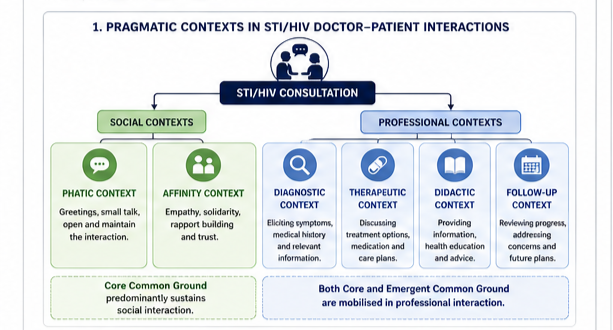
The phatic context was mainly characterised by greeting rituals and the exchange of pleasantries. The Core Common Ground (CCG) of the participants, which manifested through their Common Sense (CMS) knowledge of the medical setting and the asymmetrical power relations involved, the Cultural Sense (CS) of greetings as a social ritual and the Formal Sense (FS), which related to the linguistic representation and formulations of the greetings, all sustained the phatic context.
The analysis revealed affinity as a demonstration of fellow feelings among the participants. This context was sustained by participants’ Formal sense of the linguistic formulations of affinity enquiries, their Cultural Sense (CS) knowledge, which is deeply rooted in the Nigerian communal life philosophy, and their Common Sense (CMS) knowledge of ethnicity, history, communal relations and national exposure.
The four phases of the professional context in this study, which are diagnosis context, didactic context, therapy and follow-up contexts, constitute activities that are channeled towards arriving at a diagnosis, offering of medical advice to patients, recommending treatment for patients’ health concerns and giving instructions towards further visits to the hospital, respectively. They all have similar contextual drivers. They are sustained by the participants’ core and emergent common ground. On the slant of core common ground, participants possess and orient to their common sense of activities in the medical institution and the power asymmetry; they engage their culture sense through indirect reference to sensitive private parts of the body and the use of euphemism in their description of taboo terms; the participants’ formal sense is revealed in their correct recognition and interpretation of the linguistic indices that trigger the core aspects of the consultation, such as the problem elicitation (“madam, how now?; so, what can I do for you today?” etc. The analysis also revealed that the Participants’ emergent common ground was engaged through their shared sense and current sense of emergent issues that were brought up during the consultation (e.g. checking a rash during physical examination).
Thus, while the core common ground of the participants sustained the social contexts in our STI and HIV/AIDS interactions, both the core common ground and the emergent common ground were engaged by the doctors and the patients in the professional contexts. The study concludes that varied degrees of shared knowledge among participants –relating to common sense of the world and the medical institution, cultural sense, formal sense of linguistic coding– allows them to interpret context-specific actions correctly and cooperate across phatic, affinity, diagnostic, treatment, didactic and follow-up phases of the consultations in the hospitals.
References
Akinbola, O. O. (2012). Conversational practices and politeness constructions in selected STI clinics in Ondo State. Unpublished MA Thesis. English, Arts. University of Ibadan.
Ainsworth-Vaughn, N. (1998). Claiming power in doctor-patient talk. Oxford University Press.
Amusa, O. O. (2022). Conversational Increments in Consultative Contexts in STI and HIV/AIDS
Clinics in Ondo and Lagos States. Unpublished PhD thesis. Ibadan: University of Ibadan.
Amusa, O. O. (2023a). “The generic structure potential (GSP) of STI doctor-patient interactions in
southwest Nigeria”. Revista do GEL, Vol. 20 (2) p. 11-28.
Amusa, O. O. (2023b). “‘It will be *scratching me’: Increments in STI and HIV medical encounters in
Southwest Nigeria.” Journal of Researches in Linguistics 15:2, pp. 1– 14.
Amusa, O. O. (2025). Investigating “the thing”, “this thing”, and “that thing”: Euphemisms in medical
interactions in Nigeria. In Translation and Discourse as (Non)Discrimination (pp. 221–244). Peter Lang.
Aronsson, K., & Sätterlund-Larsson, U. (1987). Politeness strategies and doctor-patient
communication: On the social choreography of collaborative thinking. Journal of Language and Social Psychology, 6(1), 1–27
Awoleye, A. F., Solanke, B. L., Kupoluyi, J. A., & Adetutu, O. M. (2022). Exploring the perception and socio-cultural barriers to safer sex negotiation among married women in Northwest Nigeria. BMC Women’s Health, 22, 411. https://doi.org/10.1186/s12905-022-01989-3
Barfod, T. S., Hecht, F. M., Rubow, C., Gerstoft, J., & Rodkjaer, L. (2006). Physicians’ communication with patients about adherence to HIV medication in San Francisco and Copenhagen: A qualitative study using grounded theory. BMC Health Services Research, 6, 154. https://doi.org/10.1186/1472-6963-6-154
Boluwaduro, E. (2020). You must adhere strictly to the time and days of intake: medical advice
and negotiations of medical authority in Nigerian HIV consultation. Linguistik Online 102.2: 112-145.
Brody, H. (1992). The healer’s power. Yale University Press.
Brook, G., Bacon, L., Evans, C., McClean, H., Roberts, C., Tipple, C., Winter, A. J., & Sullivan, A.
K. (2014). 2013 UK national guideline for consultations requiring sexual history t aking. International Journal of STD & AIDS, 25(6), 391–404.
Brown, P., & Levinson, S. C. (1987). Politeness: Some universals in language usage. Cambridge
University Press.
Coupland, J., Coupland, N., & Robinson, J. (1992). “How are you?”: Negotiating phatic communion”.
Language and Society, 21, 207–230.
Freidson, E. (1970). Professional dominance: The social structure of medical care. Atherton
Press.
Haugh, M. (2008). “Intention in pragmatics”. Intercultural Pragmatics Vol. 5. No.2.: 99–110.
Kecskes, I. (2008). Dueling contexts: A dynamic model of meaning. Journal of Pragmatics, 40(3),
385–406. https://doi.org/10.1016/j.pragma.2007.12.004
Kecskes, I. (2014). Intercultural pragmatics. Oxford University Press.
Kecskes, I. & Zhang, W. (2009). Activating, seeking and creating common ground- a
sociocognitive approach. Pragmatics & Cognition 17.2.
Magnusson, R. S. (1994). Privacy, confidentiality and HIV/AIDS health care. Australian
Journal of Public Health, 18(1), 51–58.
Smith, D. J. (2004). Youth, sin and sex in Nigeria: Christianity and HIV/AIDS-related beliefs and
behaviour among rural-urban migrants. Culture, Health & Sexuality, 6(5), 425–437.
Heritage, J., & Maynard, D. W. (Eds.). (2006). Communication in medical care: Interaction
between primary care physicians and patients. Cambridge University Press.
Igboin, B. O. (2012). The semiotic of greetings in Yoruba culture. Cultura: International
Journal of Philosophy of Culture and Axiology, 9(2), 123–142.
Maynard, D. (1991). The perspective-display series and the delivery and receipt of diagnostic news.
Talk and Social Structure. Studies in Ethnomethodology and Conversational Analysis. Eds. D. Boden and D.H. Zimmerman. Cambridge: Cambridge. 164-192.
Maynard, D. & Hudak, P. (2008). “Small talk, high stakes: interactional disattentiveness in the
context of prosocial doctor-patient interaction.” Language in Society, 37(5): 661–88.
Odebunmi, A. & Amusa, O. O. (2016). Discursive Practices in STI/HIV Diagnostic
Encounters in Ondo State, Nigeria. Grammar, Applied Linguistics and Society: A Festschrift for Wale Osisanwo. Eds. A. Odebunmi, A, Osisanwo, S. Ekpe and H. Aduke. Obafemi Awolowo University, Ile-Ife, Nigeria. 502-545.
Odebunmi, A. (2003). Pragmatic Features of English Usage in Hospital Interactions Amongst
Medical Practitioners and Patients in Southwestern Nigeria. Thesis. English, Arts. Obafemi Awolowo University, Ile-Ife.
Odebunmi, A. (2005). Cooperation in Doctor/Patient Conversational Interactions in Southwestern
Nigeria. Perspectives on Language and Literature. Eds. M. Olateju and L. Oyeleye. Ile-Ife: Obafemi Awolowo University Press. 239-252.
Odebunmi, A. (2006). Locutions in Medical Discourse in Southwestern Nigeria. Pragmatics 16.1:
25-41
Odebunmi, A. (2008). Pragmatic strategies of diagnostic news delivery in Nigerian hospitals.
Linguistic Online 36.4: 21-37.
Odebunmi, A. (2016). ‘You didn’t give me to go and buy’: Negotiating accountability for poor
health in post-recommendation medical consultations. Journal of Pragmatics 93:1-15
Pilnick, A., & Dingwall, R. (2011). On the remarkable persistence of asymmetry in doctor/patient i
nteraction: A critical review. Social Science & Medicine, 72(8), 1374–1382.
Sacks, H., Schegloff, E. A., & Jefferson, G. (1974). A simplest systematics for the organization of
turn-taking for conversation. Language, 50(4), 696–735.
Transcription Notations
• [ ]
[ ] indicating overlap;
• (0.2) indicating elapsed time in tenths of seconds;
• (.) indicating a brief
• ( ), indicating inaudibility
• <> talk said more slowly than surrounding
• >< talk said more quickly than surrounding talk
• @ laughter
• collective laughter
• $ smile
• ::: prolongation
• ↑ ↓ high or low pitch
• (( )) transcriber’s descriptions
• WORD (upper case) loud sounds relative to the surrounding talk
• owordo word/utterance indicating that the sounds are softer than the surrounding talk
• = no break or gap
• – – indicate a short or untimed interval without talk
( adapted from https://www.universitytranscriptions.co.uk/jefferson-transcription-system-a-guide-to-the-symbols/)